The river corridor is probably the largest area of managed retreat in an urban centre worldwide. How can our experience inform processes of managed retreat elsewhere? The question is central to this project, which has developed a model of ‘retreat’, ‘relocation’ and ‘re-imagining’. Re-imagining asks how can the land be re-used for projects that further lower environmental and social risks.

Soil Contamination
Turning Waste into Climate-Resilient Soils for Communities
Researchers at the University of Canterbury are investigating whether materials such as green-waste compost, biochar and sawdust can help reduce the risks associated with heavy-metal contamination in Christchurch's Red Zone.
The project is also examining whether native plants can help build soil carbon and support ecological restoration. Researchers say the approach could be considerably cheaper than excavating contaminated soil and sending it to landfill.

UC PhD candidates Mingyuan Liu and Jack Lloyd-Scott.
The research involves UC academics Professor Brett Robinson and Dr Maria Gutierrez Gines, alongside PhD candidates Mingyuan Liu and Jack Lloyd-Scott. The project has received support from Christchurch City Council and Horizon Europe.
Based on research reported by the University of Canterbury. Click here to read the full original article:
Soil Contamination and its Effect on Biota and Land Use

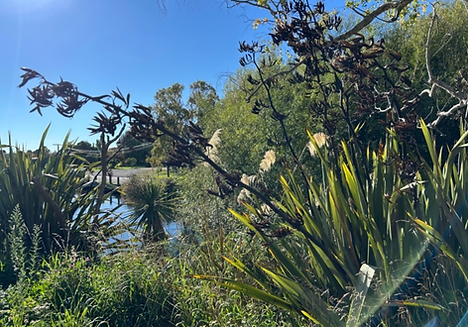
A portable X-ray fluorescence (p-XRF gun) was used to identify the elemental and chemical makeup of the soil around Harakeke, Poroporo, Karamū and Koromiko plants at sample red zone sites
Four Environmental Science Hons students are examining whether the Christchurch Residential Red Zone (RRZ) is suitable for future ecological, cultural, and commercial use by studying how soil contaminants interact with biological systems.
They are measuring trace element bioaccumulation in edible and medicinal species, specifically fungi and rongoā (traditional Māori plants), to assess food safety and mahinga kai risk, alongside soil chemistry and fertility to establish baseline contamination. Results are compared against control samples from the University of Canterbury.
Horizons EU Programme
Since July 2023, New Zealand has been an Associated Country to Pillar 2 of Horizon Europe, the EU’s flagship research and innovation programme. Christchurch City Council has secured NZD 2.9 million to deliver environmental restoration projects in the river corridor.
These are testing approaches to improve soil health, increase carbon sequestration, and
enhance biodiversity through native plantings. The city will also collaborate with international partners to explore sustainable investment models for ecological restoration.
The University of Canterbury’s role is in developing and testing strategies to build soil carbon stocks to improve the resilience of the soil to extreme climatic events brought on by climate change. UC investigates the potential of materials made from the city’s wastes, including composts (from green waste) biochar (from waste vegetation) to accelerate plant growth and increase natural carbon storage capacity.
Information from Eimi Hongo